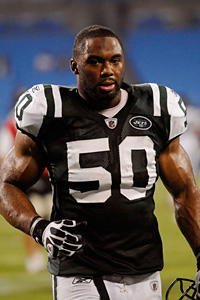
In 2008, Bears' Pro Bowl linebacker Lance Briggs tested the NFL free agent market and ultimately re-upped with the Bears for 6 years and $36million. He's exactly mid-way through this contract.
So why on earth is Briggs, through his agent Drew Rosenhaus, requesting a trade if his earlier request for a new contract is not met?
I suppose the flippant answer is because it never hurts to ask. Also, if you can get past the noble principle that once you sign a contract you should live up to it, you can understand that, since Briggs will be nearly 34 when his current contract ends, he'd like to improve on the $14.4MM left in what likely will be Briggs' NFL career.
However, the timing of the Briggs/Rosenhaus request is a little baffling. There's clearly no way that the Bears are going to re-work Briggs' contract at this point...the precedent would be awful. It's just as clear that Briggs would be foolish to attempt to use his only real leverage, a hold-out, this season...from a purely financial perspective, it's extremely unlikely that he can force the Bears' hand and would simply lose his $3.9MM 2011 salary.
The Bears had a surprisingly successful 2010 season and have had a fairly positive 2011 preseason, avoiding key injuries and somehow shoring up their woeful offensive line without making any major personnel additions. On paper at least, they're a better team than they were entering last season where they fell only one win short of playing in the Super Bowl. It's not surprising that many on the team have visions of 2011 glory dancing in their heads.
So Lance/Drew, why now? Very little positive can come from this trade request, and if you actually decide to withhold your services, you'll not only alienate your teammates (who understandably hope that their comrades can get as much as they can from management as long as it doesn't affect them or the team), but league executives as well (what good is signing a contract with someone who's proven that he won't live up to its terms and will put his own selfish interests ahead of the team). Even if you continue to play under your contract, you're putting yourself unnecessarily under a media/fan microscope...any minor injury or unproductive game will lead to speculation about whether you're using the playing field as your negotiating table.
Lance, reality check here. You're unquestionably a very good player, but not remotely a superstar. You play weakside linebacker in a defensive system designed to make your position look good, but not to rack up sacks or Sports Center highlights. What you do very well makes for great defense, but isn't very sexy/lucrative.
Drew, by all accounts, you're one of the better/more reasonable player agents. You understand that your client didn't sign any sort of "home town discount" deal back in 2008. It was pure market value...the best you could get. Since you've represented many Bears' players over the years, you also understand how, once a player hangs up his cleats, a former Bear's popularity can translate into very real money in this major market city. Chicago fans generally LOVE their former Bears' heroes, and Briggs, a very well-spoken guy, has serious post-career potential.
Unless, of course, you allow him to turn himself into a selfish, Super Bowl-sabotaging villain in Bears fans' minds. Trust me when I tell you that they won't forget this sort of unprecedented betrayal. If you let this happen, your client's financial opportunities (and your commissions) in Chicago will end on his last NFL snap.
I sincerely believe that Briggs and Rosenhaus have seriously misjudged and mishandled the situation. They're out on a pretty tenuous limb and have no one to blame but themselves. Had they had been more patient and private, just between Briggs/Rosenhaus and the Bears brass, they might have gotten something positive accomplished in 2012. Unfortunately, they put themselves and the Bears in a lose-lose situation.
While some irrevocable damage may have already been done, my advice is for Briggs to publicly "clarify" his stance quickly stating that his agent's attempt to better his lot will have no effect on his play this season.
As a general rule, no matter how far down that wrong road you may go down, the sooner you turn back the better. Lance/Drew, it's time to try to turn back.
Friday, September 2, 2011
Friday, August 5, 2011
Bears Handing Out Second Chances
When Bears' General Manager Jerry Angelo traded for franchise QB Jay Cutler, he had to give up two future first round draft choices. In a decidedly left-handed compliment, many fans praised the move in part because as they saw it, "Angelo doesn't know what to do with first-round picks anyway."
In the recently-completed free agent free-for-all, Angelo re-stocked the team's first-round stream, signing 4 former #1s to free agent contracts. That's the good news. The bad news is that each of these players is, to varying degrees, considered a disappointment to this point in his career. Let's meet the Bears' "Hell Bent for Redemption" 2011 free agent class.
Roy Williams WR 6-3 215lbs - 7th overall pick in the 2004 NFL draft
In truth, this is a third chance for Williams. He got off to a solid start with Detroit, averaging over 60 catches per year in his first 4 seasons and being selected for the 2006 Pro Bowl team. In 2008, the Calvin Johnson took over Williams' role as the Lions "go-to guy" and Detroit traded Williams in mid-season to the Cowboys for a first-round pick and 3 later-round selections.
Williams' 2 1/2 seasons in Dallas were very disappointing. Williams never caught more than 38 passes and gained a reputation as a receiver who couldn't (or wouldn't) make the big catch in traffic...some said he had a bad case of "alligator arms." It probably didn't help his popularity that, despite his lack of production with the Cowboys, Williams confidence/cockiness never wavered.
Williams reportedly signed a one-year $1.5million contract with the Bears. Frankly, this is dirt cheap for a player of Williams' talent. It's clear that Williams is placing a bet on himself and hoping that being re-united with Bears' Offensive Coordinator Mike Martz, who he worked under during his best years with the Lions, will put his career back on the rails.
Chris Spencer C 6-3 309lbs - 26th overall pick in the 2005 NFL draft
Bears' longtime alpha male center Olin Kreutz is out and Spencer is in. Centers aren't often taken in the first round and Angelo's right hand man Tim Ruskell, then the GM of the Seahawks, is the man responsible for giving Spencer this distinction. To be fair to Spencer, he's only a disappointment relative to where he was drafted. He's a good player and is a better fit for Martz's offense which values size and strength on the offensive line over speed and quickness.
Spencer reportedly signed a two-year $6million contract...pretty good money for an NFL center. Despite some early training camp talk that guard Roberto Garza may move over to start center, I don't believe it for a minute. Spencer's the guy.
Amobi Okoye DT 6-2 292lbs - 10th overall pick in the 2007 NFL draft
Okoye was only 19 when Houston drafted him. The Texans play a 3-4 defense so they lined Okoye up at nose tackle. In today's NFL, there aren't many successful nose tackles who weigh in under 300 pounds and Okoye wasn't the dominant force inside that the Texans had hoped. Coming out of college, many scouts compared Okoye to former Bear Pro-Bowler Tommie Harris because of his size and explosive quickness. The Bears hope that he'll flourish in the Bears' 4-3 defensive scheme and specifically at Harris's "3 technique" tackle position.
Of all the Bears' free agent signings, I'm most intrigued by Okoye. Okoye signed a one-year deal (amount undisclosed) so like Roy Williams, he's betting on himself. He's also betting on the expectation that, unlike Houston, the Bears will put him in a better position to succeed. He's talented, motivated and by all reports, a hard worker. Despite the fact that he has 4 NFL seasons under his belt, he just turned 24. Keep an eye on this kid.
Vernon Gholston DE 6-3 262 - 6th overall pick in the 2008 NFL draft
Coming out of Ohio State where he starred at defensive end, Gholston simply blew the scouts away at the Indianapolis combine. Speed, quickness, strength, you name it...Gholston's marks were off the charts. The Jets picked him to be a featured player in new coach Rex Ryan's attacking defense, moving him from defensive end to outside linebacker. Visions of Lawrence Taylor danced in Jets fans' heads.
Whether it was the change of position, the transition from college to the pros or something within him, Gholston was remarkably unproductive in New York. The New York press labeled him one of the most spectacular "busts" in NFL history and while they can be accused of being a little quick on the trigger (he's only played 3 seasons), the numbers don't lie...no sacks in 3 years.
Gholston's picture tops this article. The old line about a guy who "looks like Tarzan, plays like Jane" unfortunately comes to mind.
Still, the Jets' Ryan was complimentary of Gholston's coachability and progress, "The guy is an excellent teammate. He did what was asked and he got better." When asked about Gholston's low production, Ryan said, "Well, then I failed as far as the numbers go...but I thought he got better. We'll see what happens to him. He's not done playing"
Like Okoye, the Bears are hoping that the combination of a change of position (he'll have his hand on the ground with the Bears), the tutelage of Defensive Coordinator Rod Marinelli (great reputation working with defensive linemen) and a change of scenery will bring out the best in Gholston.
Gholston is yet another one of the once-highly-touted Bears' free agent signees who agreed to a one-year deal (amount undisclosed). Like Okoye, he's a low-risk/high-reward proposition.
Other Bears' Free Agent Signees
The Bears didn't limit themselves to signing other teams' former first round picks. For starters, they re-signed several of their own free agents, including DT Anthony Adams, outside linebacker Nick Roach who figures to start alongside stud LBs Brian Urlacher and Lance Briggs and center-guard Edwin Williams.
To add depth to the running back position, the Bears signed former Cowboys' RB Marion Barber. A 4th round pick in 2005, the 5-11 221lb Barber is a tough inside runner who has had two 900+ yard seasons in his 6 years in the league. He signed a two-year $5million deal and figures to be used in short-yardage situations while providing solid insurance in the event starter Matt Forte gets injured.
Last offseason, Martz told Angelo that his offense needed a big block-first tight end so they signed the genuinely massive 6-2 288lb Brandon Manumaleuna. As advertised, Manumaleuna wasn't much of a receiving option, but unfortunately he also wasn't much of a blocker. Martz got a do-over and this time the Bears went with the Steelers' Matt Spaeth. At 6-7 270lbs, Spaeth is also a block-first TE, but provides a bigger target and more speed than the failed Manumaleuna.
On special teams, the Bears told longtime punter Brad Maynard to take a hike and signed Jets punter Adam Podlesh. Rather than giving you a rundown on Podlesh, I'll let highly-respected Bears' Special Teams Coach Dave Toub handle the honors.
"Podlesh was always our No. 1 guy," Toub said. "He was always our No. 1 guy. He's the guy we targeted early way back. We were so happy to get him. As soon as we were able to call him, we tried to recruit him just like we were in college again. He fits us. He's very athletic, he runs a 4.4 [40 yard dash], he's got a great hands, he's a directional punter. He's a young Brad Maynard is what he is. He's reaching his prime right now. Again, we're very happy and pleased to have him in the mix."
Not sure what I can add other than that I was a Maynard fan and Toub better be right.
The Bears also let longtime special team stalwart Rashied Davis sign with Detroit and signed the Cowboys special teams captain and sometimes WR Sam Hurd. Again, I'll turn it over to Toub.
"We targeted Hurd during the offseason as a guy we would try to get no matter what as a free agent," Toub said. "He's an excellent special teams player. He's going to bring a lot to the table for us."
On this one I completely agree with Toub. Davis was a good player, but Hurd is better.
Frankly, I think every single free agent signing the Bears made this offseason makes sense on some level. Williams, Barber, Spaeth and Hurd are clear upgrades. Much as I respect Kreutz, I think that right now, Spencer's a better player and better suited to the Martz offense. Okoye and Gholston are fun gambles because they're both cheap...neither is expected to play a key role.
With all this said, a big part of the Bears' free agent story isn't what they did, but what they didn't do...specifically, other than the Spencer-for-Kreutz change that many feel is a net negative, they didn't bring anyone in to help shore up the 2010 team's glaring weakness on the offensive line (though I guess you could say Spaeth gets half credit). Williams and Barber are fine offensive additions, but they won't matter much if Cutler spends another season on his back, and they certainly won't matter if Cutler gets broken and the team's fortunes depend on backup QB Caleb Hanie.
The only meaningful addition to the O-line is first-round tackle Gabe Carimi. Right now, the depth chart has 2011 7th-round pick J'Marcus Webb as the starting LT, the most important position on the offensive line when it comes to the prospective health of a team's QB. I understand that Martz and offensive line coach Mike Tice are high on Webb and they know a whole lot more about football than I do, but I'd be less than honest if I didn't say that I remain nervous about LT and Cutler's health. I'm not worried about Spencer at center and I remain a fan of Garza at guard. Carimi may have some growing pains, but I like him at right tackle.
The other guard is an issue. Chris Williams, the Bears former first-round pick and failed LT of the future is now a reclamation project at guard. One of what I felt were the defining moments of the 2010 season for Williams was when the overrated/underachieving Albert Haynesworth of the Redskins flat-out freight-trained Williams like he wasn't there and destroyed poor little Cutler. Forget being a highly-touted first-round tackle...if Williams can't be a competent guard, Tice needs to replace him with a mediocre journeyman like Omiyale.
The weakness of the O-line remains the "elephant in the room" for this Bears' team.
If the Bears were making a meal, I'd praise them for their eye for value in terms of the side dishes and agree that those side dishes could be spectacular. My problem is with the main course whose success depends on the quality of their iffy offensive line.
It seems that they're confident in their meal.
The proof is in the tasting.
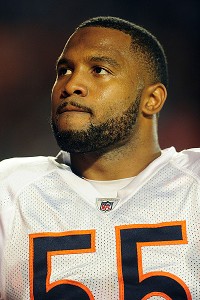
In the recently-completed free agent free-for-all, Angelo re-stocked the team's first-round stream, signing 4 former #1s to free agent contracts. That's the good news. The bad news is that each of these players is, to varying degrees, considered a disappointment to this point in his career. Let's meet the Bears' "Hell Bent for Redemption" 2011 free agent class.
Roy Williams WR 6-3 215lbs - 7th overall pick in the 2004 NFL draft
In truth, this is a third chance for Williams. He got off to a solid start with Detroit, averaging over 60 catches per year in his first 4 seasons and being selected for the 2006 Pro Bowl team. In 2008, the Calvin Johnson took over Williams' role as the Lions "go-to guy" and Detroit traded Williams in mid-season to the Cowboys for a first-round pick and 3 later-round selections.
Williams' 2 1/2 seasons in Dallas were very disappointing. Williams never caught more than 38 passes and gained a reputation as a receiver who couldn't (or wouldn't) make the big catch in traffic...some said he had a bad case of "alligator arms." It probably didn't help his popularity that, despite his lack of production with the Cowboys, Williams confidence/cockiness never wavered.
Williams reportedly signed a one-year $1.5million contract with the Bears. Frankly, this is dirt cheap for a player of Williams' talent. It's clear that Williams is placing a bet on himself and hoping that being re-united with Bears' Offensive Coordinator Mike Martz, who he worked under during his best years with the Lions, will put his career back on the rails.
Chris Spencer C 6-3 309lbs - 26th overall pick in the 2005 NFL draft
Bears' longtime alpha male center Olin Kreutz is out and Spencer is in. Centers aren't often taken in the first round and Angelo's right hand man Tim Ruskell, then the GM of the Seahawks, is the man responsible for giving Spencer this distinction. To be fair to Spencer, he's only a disappointment relative to where he was drafted. He's a good player and is a better fit for Martz's offense which values size and strength on the offensive line over speed and quickness.
Spencer reportedly signed a two-year $6million contract...pretty good money for an NFL center. Despite some early training camp talk that guard Roberto Garza may move over to start center, I don't believe it for a minute. Spencer's the guy.
Amobi Okoye DT 6-2 292lbs - 10th overall pick in the 2007 NFL draft
Okoye was only 19 when Houston drafted him. The Texans play a 3-4 defense so they lined Okoye up at nose tackle. In today's NFL, there aren't many successful nose tackles who weigh in under 300 pounds and Okoye wasn't the dominant force inside that the Texans had hoped. Coming out of college, many scouts compared Okoye to former Bear Pro-Bowler Tommie Harris because of his size and explosive quickness. The Bears hope that he'll flourish in the Bears' 4-3 defensive scheme and specifically at Harris's "3 technique" tackle position.
Of all the Bears' free agent signings, I'm most intrigued by Okoye. Okoye signed a one-year deal (amount undisclosed) so like Roy Williams, he's betting on himself. He's also betting on the expectation that, unlike Houston, the Bears will put him in a better position to succeed. He's talented, motivated and by all reports, a hard worker. Despite the fact that he has 4 NFL seasons under his belt, he just turned 24. Keep an eye on this kid.
Vernon Gholston DE 6-3 262 - 6th overall pick in the 2008 NFL draft
Coming out of Ohio State where he starred at defensive end, Gholston simply blew the scouts away at the Indianapolis combine. Speed, quickness, strength, you name it...Gholston's marks were off the charts. The Jets picked him to be a featured player in new coach Rex Ryan's attacking defense, moving him from defensive end to outside linebacker. Visions of Lawrence Taylor danced in Jets fans' heads.
Whether it was the change of position, the transition from college to the pros or something within him, Gholston was remarkably unproductive in New York. The New York press labeled him one of the most spectacular "busts" in NFL history and while they can be accused of being a little quick on the trigger (he's only played 3 seasons), the numbers don't lie...no sacks in 3 years.
Gholston's picture tops this article. The old line about a guy who "looks like Tarzan, plays like Jane" unfortunately comes to mind.
Still, the Jets' Ryan was complimentary of Gholston's coachability and progress, "The guy is an excellent teammate. He did what was asked and he got better." When asked about Gholston's low production, Ryan said, "Well, then I failed as far as the numbers go...but I thought he got better. We'll see what happens to him. He's not done playing"
Like Okoye, the Bears are hoping that the combination of a change of position (he'll have his hand on the ground with the Bears), the tutelage of Defensive Coordinator Rod Marinelli (great reputation working with defensive linemen) and a change of scenery will bring out the best in Gholston.
Gholston is yet another one of the once-highly-touted Bears' free agent signees who agreed to a one-year deal (amount undisclosed). Like Okoye, he's a low-risk/high-reward proposition.
Other Bears' Free Agent Signees
The Bears didn't limit themselves to signing other teams' former first round picks. For starters, they re-signed several of their own free agents, including DT Anthony Adams, outside linebacker Nick Roach who figures to start alongside stud LBs Brian Urlacher and Lance Briggs and center-guard Edwin Williams.
To add depth to the running back position, the Bears signed former Cowboys' RB Marion Barber. A 4th round pick in 2005, the 5-11 221lb Barber is a tough inside runner who has had two 900+ yard seasons in his 6 years in the league. He signed a two-year $5million deal and figures to be used in short-yardage situations while providing solid insurance in the event starter Matt Forte gets injured.
Last offseason, Martz told Angelo that his offense needed a big block-first tight end so they signed the genuinely massive 6-2 288lb Brandon Manumaleuna. As advertised, Manumaleuna wasn't much of a receiving option, but unfortunately he also wasn't much of a blocker. Martz got a do-over and this time the Bears went with the Steelers' Matt Spaeth. At 6-7 270lbs, Spaeth is also a block-first TE, but provides a bigger target and more speed than the failed Manumaleuna.
On special teams, the Bears told longtime punter Brad Maynard to take a hike and signed Jets punter Adam Podlesh. Rather than giving you a rundown on Podlesh, I'll let highly-respected Bears' Special Teams Coach Dave Toub handle the honors.
"Podlesh was always our No. 1 guy," Toub said. "He was always our No. 1 guy. He's the guy we targeted early way back. We were so happy to get him. As soon as we were able to call him, we tried to recruit him just like we were in college again. He fits us. He's very athletic, he runs a 4.4 [40 yard dash], he's got a great hands, he's a directional punter. He's a young Brad Maynard is what he is. He's reaching his prime right now. Again, we're very happy and pleased to have him in the mix."
Not sure what I can add other than that I was a Maynard fan and Toub better be right.
The Bears also let longtime special team stalwart Rashied Davis sign with Detroit and signed the Cowboys special teams captain and sometimes WR Sam Hurd. Again, I'll turn it over to Toub.
"We targeted Hurd during the offseason as a guy we would try to get no matter what as a free agent," Toub said. "He's an excellent special teams player. He's going to bring a lot to the table for us."
On this one I completely agree with Toub. Davis was a good player, but Hurd is better.
Frankly, I think every single free agent signing the Bears made this offseason makes sense on some level. Williams, Barber, Spaeth and Hurd are clear upgrades. Much as I respect Kreutz, I think that right now, Spencer's a better player and better suited to the Martz offense. Okoye and Gholston are fun gambles because they're both cheap...neither is expected to play a key role.
With all this said, a big part of the Bears' free agent story isn't what they did, but what they didn't do...specifically, other than the Spencer-for-Kreutz change that many feel is a net negative, they didn't bring anyone in to help shore up the 2010 team's glaring weakness on the offensive line (though I guess you could say Spaeth gets half credit). Williams and Barber are fine offensive additions, but they won't matter much if Cutler spends another season on his back, and they certainly won't matter if Cutler gets broken and the team's fortunes depend on backup QB Caleb Hanie.
The only meaningful addition to the O-line is first-round tackle Gabe Carimi. Right now, the depth chart has 2011 7th-round pick J'Marcus Webb as the starting LT, the most important position on the offensive line when it comes to the prospective health of a team's QB. I understand that Martz and offensive line coach Mike Tice are high on Webb and they know a whole lot more about football than I do, but I'd be less than honest if I didn't say that I remain nervous about LT and Cutler's health. I'm not worried about Spencer at center and I remain a fan of Garza at guard. Carimi may have some growing pains, but I like him at right tackle.
The other guard is an issue. Chris Williams, the Bears former first-round pick and failed LT of the future is now a reclamation project at guard. One of what I felt were the defining moments of the 2010 season for Williams was when the overrated/underachieving Albert Haynesworth of the Redskins flat-out freight-trained Williams like he wasn't there and destroyed poor little Cutler. Forget being a highly-touted first-round tackle...if Williams can't be a competent guard, Tice needs to replace him with a mediocre journeyman like Omiyale.
The weakness of the O-line remains the "elephant in the room" for this Bears' team.
If the Bears were making a meal, I'd praise them for their eye for value in terms of the side dishes and agree that those side dishes could be spectacular. My problem is with the main course whose success depends on the quality of their iffy offensive line.
It seems that they're confident in their meal.
The proof is in the tasting.
Thursday, June 30, 2011
NBA Lockout
In a few days, the NBA is going to lock out its players. It's pretty much inevitable.
You're going to hear and read all sorts of rhetoric from the two sides and from media members who don't really "get it." They'll try to make this a "good guys-bad guys" thing and it's anything but.
As Michael Corleone said, "It's not personal, Sonny...it's strictly business."
It's my hope here to take the saber-rattling out of this situation and give you a clearer idea of what's truly going on. Warning: this isn't really about sports, but the basic business dynamics don't require an MBA (come to think of it, I've never found anything that requires an MBA...but I digress).
Finance 101
You'll hear it said that "the NBA is making money," which is both true and completely irrelevant. The NBA is a league and it doesn't make anything. If you want to know the financial health of the NBA, you have to ask the profit or loss question 30 times...once each for the 30 actual businesses/teams that make up the NBA.
Obviously, every business would like to make a profit, but depending on their situation, this can be difficult if such "hidden expenses" like interest on debt and the amortization/depreciation of assets are high. A business could be reasonably healthy, but because of these expenses, may show a loss. This is one of the reasons why accountants and financial types keep track of "operating income." Operating income excludes these hidden expenses leaving a purer picture of revenue less operating expenses.
If you're running at an operating loss, it pretty much means that what you're paying to make your widgets is more than what you can sell them for...not good.
According to Forbes magazine, in 2010 twelve of the NBA's 30 teams posted an operating loss. That's 40% of the teams in the league and that's a decidedly bad thing. However, in my opinion, it's not quite that bad since 2 of the 12 operational losers have purely self-inflicted wounds. The Portland Trailblazers (owner is Microsoft co-founder and noted philanthropist, Paul Allen) and Dallas Mavericks (owner is Mark Cuban, who probably bought the team because of it's name) both spend on players' salaries like they're mega-market teams though they clearly are not. Put another way, they're irresponsible, but can afford to be. Oh yeah...Cuban was rewarded for his fiscal irresponsibility with an NBA title this season.
Mismanaged or Just Mid-Market?
You'll likely hear that a big part of the problem in the NBA is that too many franchises are mismanaged. I don't know if they are or aren't. However, it's pretty obvious that, if you're the New York Knicks, Chicago Bulls or the LA Lakers, you can charge a lot more for your tickets than if you're the New Orleans Hornets, Sacramento Kings or Milwaukee Bucks. Even more important, big market teams can make several times what mid-market teams can make in local TV and radio contracts.
It's not a level playing field.
Still, some mid-market teams made money in 2010. Perhaps the most notable was the Oklahoma City Thunder who posted a remarkable operating income of $12.5MM. The Thunder is the city's only big league franchise...ever. In baseball terms, they're strictly Triple-A. However, when the New Orleans Hornets needed an alternative place to play due to Hurricane Katrina, OKC was chosen and the city received the NBA so enthusiastically that the league helped engineer the move of the struggling Seattle Supersonics franchise to OKC.
The Thunder inherited a young superstar named Kevin Durant who was joined by star-in-his-own-right point guard Russell Westbrook in 2008. The Thunder's front office has done a very good job of building around their nucleus and the team has been exciting and very successful on the court.
Some will point to the Thunder as an example of a mid-market team that has done it the "right way." While I give credit to the Thunder, for the 2009-10 season, they paid Durant and Westbrook a combined $8.6MM. Durant alone will jump to $13.6MM in 2011-12 and Westbrook will soon follow that same path.
Good-bye OKC operating income.
The Crux of the Matter
Based on the current collective bargaining agreement (CBA) between the NBA players and owners, only about 20 of the current teams can be expected to break even or better in terms of operating income. In the simplest terms, this means that either the league needs to eliminate "fringe" franchises or significantly change the CBA...ideally by enough to make the current 30 teams viable.
The truth is that neither the owners nor the players want contraction. For the owners, contraction's a bad idea for two reasons - 1) having 30 significant media markets included enhances their leverage in terms of the national TV contracts and 2) having these markets in the fold minimizes the chances of the formation of a rival league. While rival leagues seldom succeed for long, they always seem to do two things while they live - raid a couple of your superstars and generally increase players' salaries.
The players, particularly the non-stars, don't want contraction for the most obvious of reasons...fewer job opportunities.
From the owners' perspective, this is where the argument ends. Contraction or making the CBA more mid-market-friendly. In the soon-to-commence public relations war, the players and their representatives will seek to add a 3rd alternative...increased revenue sharing.
NBA Revenue Sharing
As I mentioned at the beginning of this article, when taken in total, the NBA is profitable. The players, while acknowledging the financial problems of the smaller market teams, will claim that the dollars are there...they just need to be distributed more equally.
At first hearing, this may sound good, but it's an absolute non-starter from the owners perspective, and any reasonable business perspective. If you just bought a mega-market NBA franchise and paid the huge premium for the privilege, you are going to have a very serious and completely reasonable problem if someone tries to cut the (large) anticipated revenue stream that was used to set your purchase price. You'll also scream bloody murder over the fact that a significant change to the revenue sharing rules would cause the asset you just paid $500MM for to be reduced to $300MM.
When it comes to revenue sharing, it's one of those situations where you simply can't change the rules in the middle of a game.
So What's Next?
The owners pretty much laid their cards on the table when they introduced their $62MM "Flex Cap" proposal. If the union doesn't accept this in the next few days, the owners may go back to their silly posturing about a $45MM "hard cap" and the elimination of guaranteed contracts.
The problem here is that the owners' Flex Cap proposal may be close to their best offer (though the owners very purposely left key final details open to negotiation). The union treated the owners proposal like a posturing move (that is, they crapped all over it). It's possible that the players' representatives made a tactical error here that may cost both sides time and money only to have them end up in the same place they could be right now.
At the risk of repeating myself, the key point is that the owners are determined to come away with a CBA that works for 30 teams, not the current 20 teams who are or could be (if not for owner largesse) in the black in terms of operating income.
The players don't want to give up what they have and this is understandable. However, if they aren't ready to accept something very close to the owners' Flex cap proposal, the 2011-12 NBA season is unquestionably in jeopardy.
As fans, we're definitely on the outside looking in, but I hope that this helps you be a better consumer of the stuff that the media's about to throw at you.
You're going to hear and read all sorts of rhetoric from the two sides and from media members who don't really "get it." They'll try to make this a "good guys-bad guys" thing and it's anything but.
As Michael Corleone said, "It's not personal, Sonny...it's strictly business."
It's my hope here to take the saber-rattling out of this situation and give you a clearer idea of what's truly going on. Warning: this isn't really about sports, but the basic business dynamics don't require an MBA (come to think of it, I've never found anything that requires an MBA...but I digress).
Finance 101
You'll hear it said that "the NBA is making money," which is both true and completely irrelevant. The NBA is a league and it doesn't make anything. If you want to know the financial health of the NBA, you have to ask the profit or loss question 30 times...once each for the 30 actual businesses/teams that make up the NBA.
Obviously, every business would like to make a profit, but depending on their situation, this can be difficult if such "hidden expenses" like interest on debt and the amortization/depreciation of assets are high. A business could be reasonably healthy, but because of these expenses, may show a loss. This is one of the reasons why accountants and financial types keep track of "operating income." Operating income excludes these hidden expenses leaving a purer picture of revenue less operating expenses.
If you're running at an operating loss, it pretty much means that what you're paying to make your widgets is more than what you can sell them for...not good.
According to Forbes magazine, in 2010 twelve of the NBA's 30 teams posted an operating loss. That's 40% of the teams in the league and that's a decidedly bad thing. However, in my opinion, it's not quite that bad since 2 of the 12 operational losers have purely self-inflicted wounds. The Portland Trailblazers (owner is Microsoft co-founder and noted philanthropist, Paul Allen) and Dallas Mavericks (owner is Mark Cuban, who probably bought the team because of it's name) both spend on players' salaries like they're mega-market teams though they clearly are not. Put another way, they're irresponsible, but can afford to be. Oh yeah...Cuban was rewarded for his fiscal irresponsibility with an NBA title this season.
Mismanaged or Just Mid-Market?
You'll likely hear that a big part of the problem in the NBA is that too many franchises are mismanaged. I don't know if they are or aren't. However, it's pretty obvious that, if you're the New York Knicks, Chicago Bulls or the LA Lakers, you can charge a lot more for your tickets than if you're the New Orleans Hornets, Sacramento Kings or Milwaukee Bucks. Even more important, big market teams can make several times what mid-market teams can make in local TV and radio contracts.
It's not a level playing field.
Still, some mid-market teams made money in 2010. Perhaps the most notable was the Oklahoma City Thunder who posted a remarkable operating income of $12.5MM. The Thunder is the city's only big league franchise...ever. In baseball terms, they're strictly Triple-A. However, when the New Orleans Hornets needed an alternative place to play due to Hurricane Katrina, OKC was chosen and the city received the NBA so enthusiastically that the league helped engineer the move of the struggling Seattle Supersonics franchise to OKC.
The Thunder inherited a young superstar named Kevin Durant who was joined by star-in-his-own-right point guard Russell Westbrook in 2008. The Thunder's front office has done a very good job of building around their nucleus and the team has been exciting and very successful on the court.
Some will point to the Thunder as an example of a mid-market team that has done it the "right way." While I give credit to the Thunder, for the 2009-10 season, they paid Durant and Westbrook a combined $8.6MM. Durant alone will jump to $13.6MM in 2011-12 and Westbrook will soon follow that same path.
Good-bye OKC operating income.
The Crux of the Matter
Based on the current collective bargaining agreement (CBA) between the NBA players and owners, only about 20 of the current teams can be expected to break even or better in terms of operating income. In the simplest terms, this means that either the league needs to eliminate "fringe" franchises or significantly change the CBA...ideally by enough to make the current 30 teams viable.
The truth is that neither the owners nor the players want contraction. For the owners, contraction's a bad idea for two reasons - 1) having 30 significant media markets included enhances their leverage in terms of the national TV contracts and 2) having these markets in the fold minimizes the chances of the formation of a rival league. While rival leagues seldom succeed for long, they always seem to do two things while they live - raid a couple of your superstars and generally increase players' salaries.
The players, particularly the non-stars, don't want contraction for the most obvious of reasons...fewer job opportunities.
From the owners' perspective, this is where the argument ends. Contraction or making the CBA more mid-market-friendly. In the soon-to-commence public relations war, the players and their representatives will seek to add a 3rd alternative...increased revenue sharing.
NBA Revenue Sharing
As I mentioned at the beginning of this article, when taken in total, the NBA is profitable. The players, while acknowledging the financial problems of the smaller market teams, will claim that the dollars are there...they just need to be distributed more equally.
At first hearing, this may sound good, but it's an absolute non-starter from the owners perspective, and any reasonable business perspective. If you just bought a mega-market NBA franchise and paid the huge premium for the privilege, you are going to have a very serious and completely reasonable problem if someone tries to cut the (large) anticipated revenue stream that was used to set your purchase price. You'll also scream bloody murder over the fact that a significant change to the revenue sharing rules would cause the asset you just paid $500MM for to be reduced to $300MM.
When it comes to revenue sharing, it's one of those situations where you simply can't change the rules in the middle of a game.
So What's Next?
The owners pretty much laid their cards on the table when they introduced their $62MM "Flex Cap" proposal. If the union doesn't accept this in the next few days, the owners may go back to their silly posturing about a $45MM "hard cap" and the elimination of guaranteed contracts.
The problem here is that the owners' Flex Cap proposal may be close to their best offer (though the owners very purposely left key final details open to negotiation). The union treated the owners proposal like a posturing move (that is, they crapped all over it). It's possible that the players' representatives made a tactical error here that may cost both sides time and money only to have them end up in the same place they could be right now.
At the risk of repeating myself, the key point is that the owners are determined to come away with a CBA that works for 30 teams, not the current 20 teams who are or could be (if not for owner largesse) in the black in terms of operating income.
The players don't want to give up what they have and this is understandable. However, if they aren't ready to accept something very close to the owners' Flex cap proposal, the 2011-12 NBA season is unquestionably in jeopardy.
As fans, we're definitely on the outside looking in, but I hope that this helps you be a better consumer of the stuff that the media's about to throw at you.
Friday, June 24, 2011
Bulls Draft: Smart, Not Spectacular
In a typical NBA draft, there are about 15 or so players who will stay in the league longer than 5 years. Only a handful will become impact players.
By all accounts, the 2011 draft class was an exceptionally weak one.
So if you're the Bulls and you come in with the 28th, 30th and 43rd picks, you're expectations should be adjusted accordingly. The Bulls didn't find their shooting guard of the future, but then again, they didn't expect to.
Having established themselves as legitimate title contenders, the Bulls entered the draft with a dream and a plan. The dream was that they could somehow use their picks and a non-rotation player or two in a trade that would net them a shooting guard like the Grizzlies' O.J. Mayo or Houston's Courtney Lee, both players for whom the Bulls showed interest at the February trade deadline. It didn't happen in February and it didn't happen on Draft Night.
Since the dream didn't materialize, Bulls management moved quickly on their plan. Though they had 3 picks, Bulls' General Manager Gar Forman made it clear that they wanted no more than 2 rookies on their roster. The truth is that they preferred zero or one, leaving more room for veterans who could help the team immediately. Though their dream didn't come true, they executed their plan very nicely.
Nikola Mirotic
First, they traded their #28 and #43 picks for the Minnesota Timberwolves' 23rd overall pick. With that pick, they selected 20 year-old Montenegro-born power forward Nikola Mirotic. The 6-10 power forward has two things the Bulls really like. First, he's got talent...loads of it. Second, because of his contract obligations playing for the prestigious Real Madrid team, he won't be available for at least two years, saving the Bulls a roster spot. According to DraftExpress.com, for my money the foremost published source for talent evaluations of NBA prospects, "Chicago just drafted the 7th most talented player in the draft with the #23 pick." Most scouts I've read agree and feel that Mirotic would have been a top-10 selection if not for his contract commitments. The truth is that the Bulls are more than happy to have Mirotic develop his game overseas where he can get much more game action against quality competition.
While those fans whose only form of gratification is the immediate variety will be disappointed that they'll have to wait to see Mirotic in a Bulls' uniform, for Bulls' management, this was Christmas in June.
Jimmy Butler
At #30 the Bulls selected 6-8 Marquette swingman (shooting guard/small forward) Jimmy Butler. Butler's life story would be made into a movie except it already was. If you saw "The Blindside," just substitute Butler for Baltimore Ravens offensive tackle Michael Oher and switch from the gridiron to to the hardwood and the stories are virtually identical. Suffice it to say that if it's true that it's not what you achieve, but what you overcome that matters most, this kid's character is off the charts.
Character is great and all, but can the young man ball? Playing in the tough, tough Big East Conference last season, Butler averaged 16 points and 6 rebounds per game while shooting 49% from the field and 35% from the 3-point arc. Good numbers. And before you go thinking that Butler is one of those productive college players who lack the athleticism for the NBA, be advised that he posted a 39-inch vertical leap at the combine, just an inch short of what Derrick Rose did. The two words most often associated with Butler are versatility and defense...good words.
While it's always a longshot for a 30th pick to make it in the NBA, Jimmy Butler's overcome much worse.
It's not surprising that few fans are doing cartwheels over the Bulls' draft. Still, I think the Bulls did a great job of executing their pre-draft plan and for this deserve at least polite applause.
By all accounts, the 2011 draft class was an exceptionally weak one.
So if you're the Bulls and you come in with the 28th, 30th and 43rd picks, you're expectations should be adjusted accordingly. The Bulls didn't find their shooting guard of the future, but then again, they didn't expect to.
Having established themselves as legitimate title contenders, the Bulls entered the draft with a dream and a plan. The dream was that they could somehow use their picks and a non-rotation player or two in a trade that would net them a shooting guard like the Grizzlies' O.J. Mayo or Houston's Courtney Lee, both players for whom the Bulls showed interest at the February trade deadline. It didn't happen in February and it didn't happen on Draft Night.
Since the dream didn't materialize, Bulls management moved quickly on their plan. Though they had 3 picks, Bulls' General Manager Gar Forman made it clear that they wanted no more than 2 rookies on their roster. The truth is that they preferred zero or one, leaving more room for veterans who could help the team immediately. Though their dream didn't come true, they executed their plan very nicely.
Nikola Mirotic
First, they traded their #28 and #43 picks for the Minnesota Timberwolves' 23rd overall pick. With that pick, they selected 20 year-old Montenegro-born power forward Nikola Mirotic. The 6-10 power forward has two things the Bulls really like. First, he's got talent...loads of it. Second, because of his contract obligations playing for the prestigious Real Madrid team, he won't be available for at least two years, saving the Bulls a roster spot. According to DraftExpress.com, for my money the foremost published source for talent evaluations of NBA prospects, "Chicago just drafted the 7th most talented player in the draft with the #23 pick." Most scouts I've read agree and feel that Mirotic would have been a top-10 selection if not for his contract commitments. The truth is that the Bulls are more than happy to have Mirotic develop his game overseas where he can get much more game action against quality competition.
While those fans whose only form of gratification is the immediate variety will be disappointed that they'll have to wait to see Mirotic in a Bulls' uniform, for Bulls' management, this was Christmas in June.
Jimmy Butler
At #30 the Bulls selected 6-8 Marquette swingman (shooting guard/small forward) Jimmy Butler. Butler's life story would be made into a movie except it already was. If you saw "The Blindside," just substitute Butler for Baltimore Ravens offensive tackle Michael Oher and switch from the gridiron to to the hardwood and the stories are virtually identical. Suffice it to say that if it's true that it's not what you achieve, but what you overcome that matters most, this kid's character is off the charts.
Character is great and all, but can the young man ball? Playing in the tough, tough Big East Conference last season, Butler averaged 16 points and 6 rebounds per game while shooting 49% from the field and 35% from the 3-point arc. Good numbers. And before you go thinking that Butler is one of those productive college players who lack the athleticism for the NBA, be advised that he posted a 39-inch vertical leap at the combine, just an inch short of what Derrick Rose did. The two words most often associated with Butler are versatility and defense...good words.
While it's always a longshot for a 30th pick to make it in the NBA, Jimmy Butler's overcome much worse.
It's not surprising that few fans are doing cartwheels over the Bulls' draft. Still, I think the Bulls did a great job of executing their pre-draft plan and for this deserve at least polite applause.
Wednesday, June 22, 2011
NBA Proposal - A Hard Cap by Any Other Name
NBA Commissioner David Stern and the NBA owners got down to business yesterday. They jumped off their kind of silly saber-rattling initial proposal (a $45million hard cap and the end of guaranteed-contracts) and unveiled what they're really looking for.
The current collective bargaining agreement (CBA) between the league and the players includes a "soft" salary cap that is set at 51% of league basketball-related income divided by 30 teams. For the 2010-11 season, the team salary cap was just over $58million. However, the current CBA contains several "exceptions" which allow teams to exceed the cap. This is why it gets its "soft" designation. The fact is that only about 1/3 of the teams in the league are actually at or under the current cap and teams like the Los Angeles Lakers and Orlando Magic have payrolls of around $90million. So yes, it can often be a very soft cap.
What the owners proposed is something they're calling a "flex cap" which is ironic because its revolutionary feature (for the NBA) is that it is in fact a hard cap design. In essence, the owners' proposal would retain its main salary cap and would even increase it to $62million. They would also retain the key salary cap exceptions including the "Larry Bird" exception (allows a team to go over the cap to sign its own player) and the "Mid-Level" exception, or MLE (allows a team that's over the cap to sign one or more free agent players so long as the total salary added doesn't exceed the league's average salary, currently around $5million). Sounds reasonable so far.
The Catch
The owners proposal was for a yet-to-be-negotiated minimum team salary and a maximum team salary. It's the maximum team salary that is controversial because, as the owners presented it, none of the exceptions that allow teams to exceed the salary cap figure would apply when it comes to the maximum team salary, that is, the maximum team salary is the hard cap.
Cleverly, the owners didn't propose the upper and lower bands of their proposal. Essentially, they've told the players that "once you buy into our overall design, we can be somewhat flexible about the actual numbers." The problem is that the players have said that they'll never accept a hard cap and correctly see that this is exactly what the owners have proposed.
The Philosophy of a Hard Cap
Most fans view a hard salary cap as a way for the owners to control overall player salary costs. However, the truth is that the NBA has a very effective control of overall player salaries built in to the current CBA. The players' salaries are guaranteed not to exceed 57% of revenues. An 8% deduction is taken from each player's salary and put into an escrow account. If player salaries exceed the 57%, the owners receive the overage from this escrow account, and if the total escrow account is insufficient, player salary deductions are increased the following season.
So why a hard cap? Why not just fiddle with the 57% figure? Good question and it's exactly the question the players are asking. The reason is that, for the NBA, the hard cap is about enhancing competition (or "parity"), not cost control. The current CBA includes a "Luxury Tax" provision that sets the tax level at 61% of basketball-related income (divided by 30 teams). Last year the tax trigger was about $70million, or $12million over the salary cap. For each dollar a team exceeds the $70million level, that team must pay a dollar of tax. After the season, the tax pool is divided among the teams that did not have to pay the tax.
The plain truth is that the Luxury Tax has been a failure. For the 2010-11 season, 7 teams exceeded the tax trigger point. The combined record of these 7 teams was 352-242 and only one of them had a losing record (Utah Jazz at 39-43). Once again, the league champion was among the Luxury Tax teams (Dallas Mavericks at $86.6million).
By insisting on an absolute maximum salary, the league hopes that their mid-market teams like the Sacramento Kings, Minnesota Timberwolves and Cleveland Cavaliers will be better able to compete with their big-market brothers and that this will open the road to their financial health.
Hard Cap Not All the Owners Want
Sort of lost in all the talk about the owners' hard cap/flex cap proposal is that they also want a 50%-50% revenue split with the players. As mentioned, the players currently receive 57%. This is hardly an insignificant aspect of the owners' proposal and may actually be more important to the owners than the hard cap since, in the end, virtually all labor negotiations are about how the revenue pie is split.
Unfortunately for fans, this situation is looking very similar to the NHL negotiations of a few years ago. In that case, the owners insisted on both a bigger piece of the pie and a hard cap. The players said they were flexible on the revenue split, but would never accept the hard cap.
The entire 2004-05 NHL season was lost.
The current collective bargaining agreement (CBA) between the league and the players includes a "soft" salary cap that is set at 51% of league basketball-related income divided by 30 teams. For the 2010-11 season, the team salary cap was just over $58million. However, the current CBA contains several "exceptions" which allow teams to exceed the cap. This is why it gets its "soft" designation. The fact is that only about 1/3 of the teams in the league are actually at or under the current cap and teams like the Los Angeles Lakers and Orlando Magic have payrolls of around $90million. So yes, it can often be a very soft cap.
What the owners proposed is something they're calling a "flex cap" which is ironic because its revolutionary feature (for the NBA) is that it is in fact a hard cap design. In essence, the owners' proposal would retain its main salary cap and would even increase it to $62million. They would also retain the key salary cap exceptions including the "Larry Bird" exception (allows a team to go over the cap to sign its own player) and the "Mid-Level" exception, or MLE (allows a team that's over the cap to sign one or more free agent players so long as the total salary added doesn't exceed the league's average salary, currently around $5million). Sounds reasonable so far.
The Catch
The owners proposal was for a yet-to-be-negotiated minimum team salary and a maximum team salary. It's the maximum team salary that is controversial because, as the owners presented it, none of the exceptions that allow teams to exceed the salary cap figure would apply when it comes to the maximum team salary, that is, the maximum team salary is the hard cap.
Cleverly, the owners didn't propose the upper and lower bands of their proposal. Essentially, they've told the players that "once you buy into our overall design, we can be somewhat flexible about the actual numbers." The problem is that the players have said that they'll never accept a hard cap and correctly see that this is exactly what the owners have proposed.
The Philosophy of a Hard Cap
Most fans view a hard salary cap as a way for the owners to control overall player salary costs. However, the truth is that the NBA has a very effective control of overall player salaries built in to the current CBA. The players' salaries are guaranteed not to exceed 57% of revenues. An 8% deduction is taken from each player's salary and put into an escrow account. If player salaries exceed the 57%, the owners receive the overage from this escrow account, and if the total escrow account is insufficient, player salary deductions are increased the following season.
So why a hard cap? Why not just fiddle with the 57% figure? Good question and it's exactly the question the players are asking. The reason is that, for the NBA, the hard cap is about enhancing competition (or "parity"), not cost control. The current CBA includes a "Luxury Tax" provision that sets the tax level at 61% of basketball-related income (divided by 30 teams). Last year the tax trigger was about $70million, or $12million over the salary cap. For each dollar a team exceeds the $70million level, that team must pay a dollar of tax. After the season, the tax pool is divided among the teams that did not have to pay the tax.
The plain truth is that the Luxury Tax has been a failure. For the 2010-11 season, 7 teams exceeded the tax trigger point. The combined record of these 7 teams was 352-242 and only one of them had a losing record (Utah Jazz at 39-43). Once again, the league champion was among the Luxury Tax teams (Dallas Mavericks at $86.6million).
By insisting on an absolute maximum salary, the league hopes that their mid-market teams like the Sacramento Kings, Minnesota Timberwolves and Cleveland Cavaliers will be better able to compete with their big-market brothers and that this will open the road to their financial health.
Hard Cap Not All the Owners Want
Sort of lost in all the talk about the owners' hard cap/flex cap proposal is that they also want a 50%-50% revenue split with the players. As mentioned, the players currently receive 57%. This is hardly an insignificant aspect of the owners' proposal and may actually be more important to the owners than the hard cap since, in the end, virtually all labor negotiations are about how the revenue pie is split.
Unfortunately for fans, this situation is looking very similar to the NHL negotiations of a few years ago. In that case, the owners insisted on both a bigger piece of the pie and a hard cap. The players said they were flexible on the revenue split, but would never accept the hard cap.
The entire 2004-05 NHL season was lost.
Monday, May 30, 2011
J.R. Smith
This summer, I expect to hear J.R. Smith's name brought up repeatedly in connection with the Bulls. I don't really feel like dealing with Smith piecemeal so I might as well get my feelings out on the table.
For those unfamiliar with Smith, he's a 25 year-old 6-6 shooting guard who has played the last 4 seasons for the Denver Nuggets. In 2004, the New Orleans Hornets signed him out of high school as the 18th overall pick in the NBA draft. After two years with New Orleans, he was traded as "filler" in the trade that brought P.J. Brown to the Bulls and sent Tyson Chandler to New Orleans. The Bulls kept Smith for 6 days...as long as it took to get a couple 2nd round picks from the Nuggets...the Bulls had absolutely no interest in Smith.
Smith is an extremely talented scorer, averaging 18.8 points per 36 minutes over his 7-year NBA career. He's also adequately efficient with a career true shooting percentage of 54.7%. I haven't watched many of his games since neither New Orleans nor Denver tend to get a lot of national TV run. From what I've seen, he's got a huge "Wow Factor." Unfortunately, he's also got a huge "WTF Factor." He's an indiscriminate shooter.
He's a career 37% 3-point shooter, which is OK, but that doesn't really tell the story. When Smith is on, he doesn't just make 3-pointers, he makes 3-pointers from what ought to be 4-point range....with a hand in his face...and off balance. Seriously, he can be amazing.
Cutting to the chase, I have no interest in Smith...zero. He's a bit of a whack job and a coach's nightmare. While I haven't seen many of his games, I can recognize a million dollar player with a 10 cent head when I see him.
This is what Smith is. Someday someone might rehabilitate him and he could become an absolute jewel. The Bulls need to make some incremental improvement, but they don't need to take this kind of risk.
As a 19 year-old rookie, New Orleans head coach Byron Scott started Smith in 56 of the 76 games Smith played, but only played him 24 minutes per game. After that rookie season, the uber-talented Smith has been a bench player. It's the kind of thing that makes you go "hmm." And it's not as if he's been coached by clueless novices...Scott and Denver head coach George Karl know the game. Even when the Nuggets lost their top scorer Carmelo Anthony, Karl didn't start Smith or see fit to play him big minutes. In their 2011 playoff loss to the Oklahoma City Thunder, Karl played Smith a paltry 15 minutes per game.
It's been said that it got to the point that Karl refused to talk to Smith. He'd send him in the game from time to time, but didn't want to deal with him. For those keeping track, this is not a good thing.
Oh yeah, part of the reason many Bulls fans are all gaga about Smith is that Smith is a free agent. Smith supporters believe that he'll be available for the mid-level exception (aka the MLE...about $5million year 1 salary and, since the Bulls are over the salary cap. the only way that they can sign a free agent outright). If the Bulls could sign Smith with the MLE, they wouldn't need to trade any of their current players.
Pure and simple, Smith's a headcase. While he undeniably has loads of talent, he's never quite taken the game or his career seriously. After 7 seasons, I happen to believe that those who believe that this might change with the Bulls are simply foolish optimists. These fans will counter with something like, "Yeah, but the Bulls have to do something!"
I hear ya, but the Bulls won 62 games and don't need to employ a roulette wheel strategy to the team's improvement. They don't need to "take a flyer" on a proven loser...and that's what J.R. Smith is...a proven loser.
For those unfamiliar with Smith, he's a 25 year-old 6-6 shooting guard who has played the last 4 seasons for the Denver Nuggets. In 2004, the New Orleans Hornets signed him out of high school as the 18th overall pick in the NBA draft. After two years with New Orleans, he was traded as "filler" in the trade that brought P.J. Brown to the Bulls and sent Tyson Chandler to New Orleans. The Bulls kept Smith for 6 days...as long as it took to get a couple 2nd round picks from the Nuggets...the Bulls had absolutely no interest in Smith.
Smith is an extremely talented scorer, averaging 18.8 points per 36 minutes over his 7-year NBA career. He's also adequately efficient with a career true shooting percentage of 54.7%. I haven't watched many of his games since neither New Orleans nor Denver tend to get a lot of national TV run. From what I've seen, he's got a huge "Wow Factor." Unfortunately, he's also got a huge "WTF Factor." He's an indiscriminate shooter.
He's a career 37% 3-point shooter, which is OK, but that doesn't really tell the story. When Smith is on, he doesn't just make 3-pointers, he makes 3-pointers from what ought to be 4-point range....with a hand in his face...and off balance. Seriously, he can be amazing.
Cutting to the chase, I have no interest in Smith...zero. He's a bit of a whack job and a coach's nightmare. While I haven't seen many of his games, I can recognize a million dollar player with a 10 cent head when I see him.
This is what Smith is. Someday someone might rehabilitate him and he could become an absolute jewel. The Bulls need to make some incremental improvement, but they don't need to take this kind of risk.
As a 19 year-old rookie, New Orleans head coach Byron Scott started Smith in 56 of the 76 games Smith played, but only played him 24 minutes per game. After that rookie season, the uber-talented Smith has been a bench player. It's the kind of thing that makes you go "hmm." And it's not as if he's been coached by clueless novices...Scott and Denver head coach George Karl know the game. Even when the Nuggets lost their top scorer Carmelo Anthony, Karl didn't start Smith or see fit to play him big minutes. In their 2011 playoff loss to the Oklahoma City Thunder, Karl played Smith a paltry 15 minutes per game.
It's been said that it got to the point that Karl refused to talk to Smith. He'd send him in the game from time to time, but didn't want to deal with him. For those keeping track, this is not a good thing.
Oh yeah, part of the reason many Bulls fans are all gaga about Smith is that Smith is a free agent. Smith supporters believe that he'll be available for the mid-level exception (aka the MLE...about $5million year 1 salary and, since the Bulls are over the salary cap. the only way that they can sign a free agent outright). If the Bulls could sign Smith with the MLE, they wouldn't need to trade any of their current players.
Pure and simple, Smith's a headcase. While he undeniably has loads of talent, he's never quite taken the game or his career seriously. After 7 seasons, I happen to believe that those who believe that this might change with the Bulls are simply foolish optimists. These fans will counter with something like, "Yeah, but the Bulls have to do something!"
I hear ya, but the Bulls won 62 games and don't need to employ a roulette wheel strategy to the team's improvement. They don't need to "take a flyer" on a proven loser...and that's what J.R. Smith is...a proven loser.
Friday, May 27, 2011
Bulls-Heat: Sudden Death
I knew the song was coming to an end, but I thought there was at least one more verse.
To state the obvious, the ending to Thursday night’s Game 5 was an awful way to end a truly wonderful season. The Bulls who kept surprising us all season, surprised us one more time. The last 3 minutes were like watching a train wreck in slow motion. TNT should have posted some sort of warning.
Forget the uneven officiating and Lebron’s theatrics, in those last 3 minutes, the Heat proved to be unquestionably better than the Bulls. Their defense was stifling, allowing the Bulls only 4 shots (made only 1). Their offense was a crushing combination of James and Wade hitting well-defended shot after well-defended shot, three of them from beyond the arc. Their superstars shined. Meanwhile, Rose lived out a 3-minute nightmare committing 2 turnovers, the cardinal sin of fouling Wade on a 3-pointer and a critical missed free throw.
It’s no wonder that most Bulls’ fans went to bed feeling more than a little traumatized by the whole thing.
What next?
This is the topic du jour and will continue to be for the next several months. The Bulls won 62 games during the regular season. They’re a very good team, but Miami is better. Conventional wisdom says that the Heat will be THE destination for quality role players, eliminating their current “Achilles heel” of quality depth. The job of Gar Forman and John Paxson will be to somehow leapfrog the Heat. This won’t be easy.
Ideally, the Bulls like every other team, would like to have big-minute players at each position who are effective at both ends of the court. Of course, few teams do, but currently they only have two players who match this job description…Rose and Deng. Adding one more of these is priority #1. All of the Bulls’ significant players are signed for next season with the exception of veteran big man Kurt Thomas who will be 39 next season. They may need to replace him, but otherwise their dealings should be related to upgrades.
As most know, leaving coaching aside, there are basically 4 ways to improve an NBA team – the draft, trades, free agency and the development of existing players. The Bulls have 2 first-round picks in the upcoming draft, but they’re #28 and #30 (last) so you’d need to be a big time optimist to believe that any real help will be found through the draft. It’s more likely that one or both of these picks will be traded, and if they’re used, it may be for a Euro-type player who would not join the team for a year or two (similar to what they did with rookie center Omer Asik who was a 2nd-round pick in 2008).
Rose, Noah, Deng, Gibson, Brewer and Asik are young players with great work ethics. Rose and Deng both added three-point range to their games this season and figure to become more consistent. Noah, Gibson and Asik need to work on their strength and offensive games, but Brewer is the player to keep an eye on.
Brewer is already an elite defender at the shooting guard position with great size (6-7), quickness and instincts. His glaring weakness is outside shooting. His form is ugly due to a broken arm he suffered when he was a kid that doesn’t allow him to keep his elbow and hand in a straight line to the rim. I don’t know how much he has worked on his shot, but as Jim Furyk has proven in golf, even if your stroke is a bit funky, if you work on it long enough, you might just be able to make chicken salad from chicken bleep. If somehow Brewer could shoot as well for a season as he did in these playoffs (43% on 3s), the Bulls would find their 3rd two-way player in their own backyard. Well, a guy can dream, can’t he?
Free Agency and Trades
Because the NBA’s labor contract expires after this season, the salary cap and trade rules are up in the air, and as a result, so are free agency and trades. Assuming the new contract is shaped in a similar fashion to the current one, the Bulls will be over the salary cap so their free agent dealings will be limited to the “Mid-level Exception (MLE)” and minimum-salary players. The MLE allows a team that’s over the cap to sign one or more free agents up to a combined maximum first-year salary equal to the average salary in the league (currently about $5million).
In terms of the MLE, most of the talk has centered around shooting guards Jason Richardson of the Orlando Magic, Aaron Afflalo of the Denver Nuggets and J.R. Smith, also of the Nuggets. There’s a problem with each of these players.
Richardson is an unrestricted free agent who was paid $14.4million this season. Coming off a season where he averaged about 16 points per game on 45% shooting (40% on 3s), it’s unlikely he’ll be able to match his 2010-11 salary, but since he’s still in his prime (age 30) expecting him to settle for the MLE salary is a iffy at best.
Afflalo is an uber-efficient scorer (2nd among all shooting guards with a positively stellar 62.0% true shooting %) with adequate size (6-5) and is a known as a good defender. While he’s not really a guard who’s particularly good at creating his own shot, he’s far better at this than Bogans. The problem with Afflalo is that he’s a restricted free agent, so Denver can keep Afflalo by simply matching any offer Afflalo receives. Particularly with Denver’s former franchise player Carmelo Anthony gone, most believe that the Nuggets will not let Afflalo get away.
Smith has mad skills. When he’s on, he’s unstoppable…inside, outside, doesn’t matter. He has good size at 6-6 and is capable of playing sound defense. He’s an unrestricted free agent, and while he made $6.8million last season, most observers believe that he’ll be available for the MLE…maybe even less. In his 7-year NBA career, Smith has averaged 19 points, 4 rebounds and 4 assists per 36 minutes. Right about now you’re probably asking, “OK, what’s the catch?” Just one...Smith is both a certifiable head case and a basketball idiot. Despite his obvious talent, other than his rookie season, none of his head coaches have ever seen fit to start Smith more than 25 games or play him for more than 28 minutes per game. He was actually a Bull for 6 days in 2006 as part of the sign-and-trade deal for power forward P.J. Brown. Paxson kept Brown and got rid of Smith just as quickly as he could. There are many who believe that the Bulls should take the risk on Smith. Personally, I don’t see it.
As always, the trade possibilities are limited only by the imagination and fans tend to have very vivid imaginations. You’ll hear titillating names like Dwight Howard and Ray Allen. My advice is to ignore this talk. Howard is next season’s Carmelo, but the Bulls are poorly positioned for either an offseason of in-season trade since Joakim Noah’s on something called “base year compensation” which will make him hard to trade during next season. Allen is a modern athletic marvel, who at 35 remains the prototypical shooting guard. The thing is, he has a $10million player option for next season that includes a 15% “trade kicker” (so he’d get 11.5% if traded). The Bulls don’t have any cap space to sign him as a free agent and don’t figure to have the assets the Celtics would want to trade for him.
One name you’ll hear a lot is Memphis Grizzlies’ shooting guard O.J. Mayo. Mayo was the 3rd overall pick of the 2008 draft so he’s got some talent. At 6-4 he lacks the size of an ideal shooting guard, but he does provide the “secondary creator” ability that many feel the Bulls need…he can score by putting the ball on the floor. He’s an adequate, but by no means great 3-point shooter (36% this season). Defensively, he’s not as good as either Bogans or Brewer, but worlds better than Korver. Rumor had it that the Bulls tried to trade for Mayo during the season, but were unwilling to part with either Gibson or Asik.
The other shooting guard who seems to be on the Bulls’ radar is the Houston Rockets’ Courtney Lee. Like Mayo, the Bulls were rumored to have interest in acquiring Lee at the trade deadline, but the Bulls weren’t willing to part with one of their young bigs. Like Afflalo, Lee is not really a “create his own shot” guy, but is a good all-around player who has adequate (6-5) size and can hit the 3-point shot (41% this season).
While I don’t think Richardson’s will settle for MLE money, if he does, there’s a good chance he’ll be a Bull. It remains to be seen whether the unsuccessful end to the season has changed the Bulls’ front office’s mind on trading Gibson or Asik and whether those other teams are still interested.
Boozer
It seems that everyone wants to trade Boozer. Although I totally get why you might want to trade him, it’s pretty crazy to believe that there’s any sort of market for him. The plain fact is that Boozer at age 29 is coming off one of his worst statistical seasons, easily had his worst postseason performance and is going on the 2nd year of a very lucrative 5-year contract. Seriously, you couldn’t possibly be in more of a buy high-sell low situation. Boozer performed like a MLE player but is priced at 3 times that amount. What exactly do you figure you’ll get?
As for me, I believe we’re stuck with him. As an unabashed aficionado of defensive excellence, Boozer unquestionably offends my sensibilities. Still, unlike the last Bulls’ albatross contract (Ben Wallace), at least Boozer seems to be a good teammate. My guess is that Boozer is here to stay, at least for next season. This said, if Boozer can be used in any ort of upgrade trade, count me in.
Noah
I have to admit that I’m surprised that many fans are turning on Noah. I also should say that Noah’s my favorite Bulls’ player. For those who want to see him traded, I’d be shocked if it happened in the next 12 months. In fact, I’ll be shocked if it happens at all for someone other than Howard. Like him or don’t, he’s a defensive genius (no other big I’ve seen is as versatile a defender) and an important electrical power source for the team. Above all, Noah’s a gamer. Do I second-guess Thibodeau sitting him in the 4th quarter of game 5? No, I first-guessed him. Whenever the game is on the line, I want Noah in there. As I see it, Thibodeau made a bad decision by keeping Kurt Thomas in the game.
Noah is an extraordinary defender who can score 10+ points per game without taking any shots from your true scorers. How many players can you say that about?
Korver-Brewer
If the Bulls can find a shooting guard that can both start and finish games, they’re going to need to unload either Korver or Brewer. Ideally, which one exits depends on whether the newly-acquired player is stronger at offense or defense. In any case, if the Bulls are fortunate enough to acquire a 30+ minute shooting guard, one of Korver or Brewer is gone.
In retrospect
The Bulls had one helluva season…way better than any of us had any right to expect. Personally, they provided me with more entertainment than I could ever have imagined back in October. For this I sincerely thank them…it was a great gift.
They’ve now raised the bar. Next season we will reasonably expect the Eastern Conference Finals. The best guess is that the Heat will be waiting. Will we be good enough this time?
I want the answer to be yes. Get to work, GarPax.
Subscribe to:
Posts (Atom)